
SAN JOSÉ DEL CABO, Mexico— The deserts of Baja California have been testing Ford vehicles for nearly six decades. Long before Raptor became synonymous with off-road performance, the original Ford Bronco was carving its place in racing history across the peninsula's unforgiving terrain. It was here that Ford helped shape the early years of desert racing, and where generations of drivers and engineers have returned to discover just how far their machines could go.
Nearly 60 years later, the Bronco name has once again emerged victorious from one of motorsport's most demanding challenges.
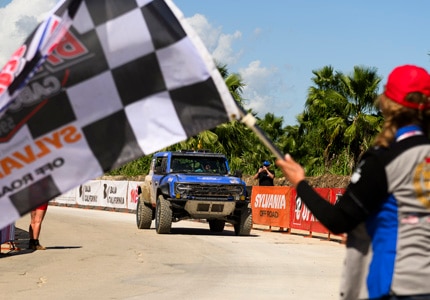
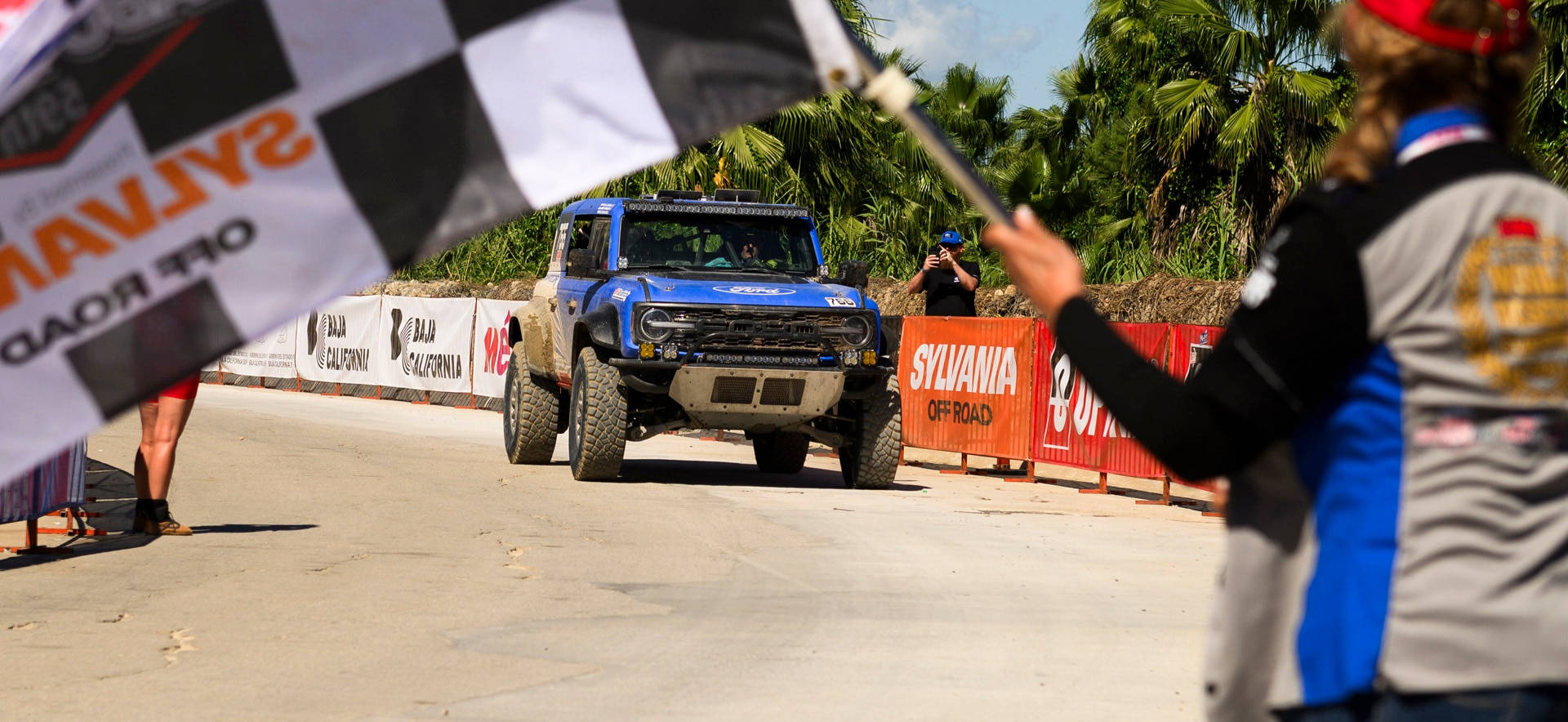
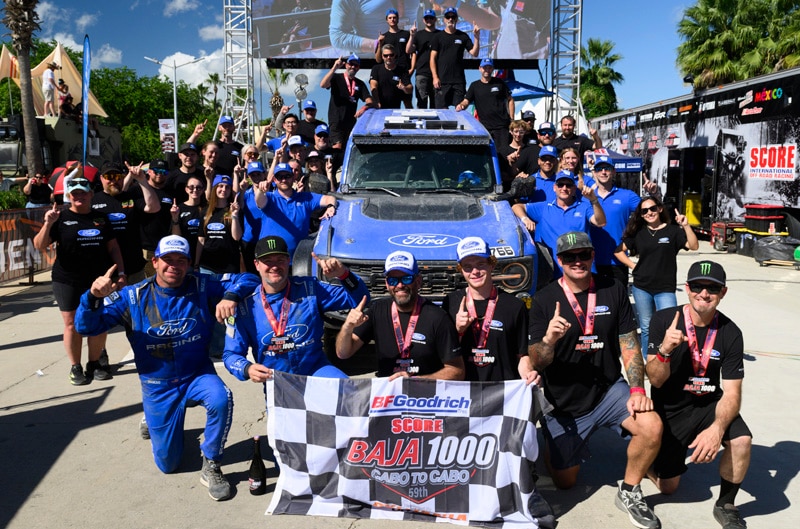
Ford Racing claimed the Stock Mid-Size class victory at the 2026 SCORE Baja 1000 with its newly built Ford Bronco Raptor, driven by Brad Lovell, Vaughn Gittin Jr. and Loren Healy, completing the 960-mile course in a time of only 24 hours and 8 minutes. The result extends Ford's recent success in Baja and marks another milestone in a year celebrating 125 years of Ford Racing.
For 2026, Ford Racing introduced updates to cooling, filtration, suspension and vehicle calibration. New hydraulic bump stops help manage severe suspension impacts, while revised components and developmental calibrations are designed to improve performance and durability across challenging terrain.
Over 970 miles of desert racing, the Bronco Raptor faced the rugged mountain passes, rocky trails, sand washes and high-speed stretches of Baja California Sur, completing a demanding loop that began and ended in San José del Cabo for the first time in history.
For Ford Racing, the victory carries significance that reaches well beyond the finish line. It continues a relationship with the Baja 1000 that began with the earliest generations of Bronco and remains central to the development of Ford's modern off-road vehicles.
“There's something special about winning in Baja because of what this place means to Ford,” said Mark Rushbrook, global director, Ford Racing. “You can trace so much of our off-road history back to these deserts, from Rod Hall and the original Bronco to Parnelli Jones and Big Oly. Those early racers helped establish a philosophy that still guides us today: take on the toughest challenges, learn everything you can and build better production vehicles because of it. To see this new Bronco Raptor carry that history forward with another Baja 1000 victory, especially as we celebrate 125 years of Ford Racing, is something we're incredibly proud of. This team has earned its place in that story.”
A LEGACY BORN IN THE DESERT
In 1969, Rod Hall and Larry Minor drove a Bill Stroppe-prepared Ford Bronco to overall victory at the Mexican 1000, an achievement that remains one of the most celebrated moments in the history of the Baja 1000. The victory established Bronco as a serious contender in desert racing and helped cement Ford's relationship with a competition that was still finding its identity. Two years later, Parnelli Jones and Bill Stroppe introduced the legendary Big Oly Bronco, a machine that challenged conventional thinking about desert racing design. Its victories in 1971 and 1972 helped define an era, turning Bronco into one of the most recognizable names in off-road motorsport.
Those early successes laid the groundwork for decades of Ford involvement in desert racing, from the celebrated Rough Riders program of the 1990s to today's global Ford Racing off-road Raptor operation.
The modern Bronco has continued that legacy. In 2024, Ford Racing secured Baja 1000 class victories with Bronco DR and Ranger Raptor. A year later, Ford returned to victory lane with both the F-150 Raptor and Bronco Raptor, demonstrating the capability of its production-based off-road vehicles.
Now, the newly built Bronco Raptor has added another chapter to that history.
“There’s certainly a race-to-road story at Ford,” said Brad Lovell. “The technology and the culture around desert racing go right into the Raptor products. We’ve been racing stock Raptors down here for five years now, and we’ve had five victories. We’ve had really clean races with all of them, and I think the lines between production trucks and race trucks are starting to blur a little bit. You’re seeing it in the results here. We’re 65th overall, officially, and that’s getting pretty quick for production trucks. I’m so proud of our effort and our team. We had zero issues with Ford systems and zero mechanical issues with the truck the entire race. That speaks volumes about the Ford Racing engineers down here and the team that built and prepared the truck.”
THE BRONCO RAPTOR: A NEW GENERATION OF DESERT RACING
While the history of Bronco in Baja stretches back generations, the technology behind its latest victory reflects the continued evolution of Ford's off-road racing program.
The 2026 Baja 1000 marked the competition debut of a newly developed Bronco Raptor race truck, engineered to build upon the capabilities of its production counterpart while incorporating targeted
improvements for the demands of sustained desert competition.
At its core is a production-based 3.0-liter EcoBoost V6 engine, paired with FOX Live-Valve suspension technology that shares its engineering foundation with the Bronco Raptor available to Ford customers. The truck also features 37-inch BFGoodrich racing tires, Method Race Wheels and additional race-specific safety and performance equipment. Calibration updates will be used to inform future iterations of customer Raptors in the continuous effort to use racing to make better products.
The Baja 1000 presents an unusual engineering challenge. Unlike shorter competitions, where outright speed can determine the outcome, success in Baja demands a vehicle capable of maintaining its performance across hundreds of miles of constantly changing terrain. The same suspension components, powertrain systems and cooling architecture must withstand repeated punishment for hours on end.
For Ford Racing, that makes Baja an essential proving ground.
“Last year, we battled the desert pretty hard, and the desert beat us in a couple of places,” said Kristen Goslawski, off-road motorsports program management supervisor, Ford Racing. “We came back with some very targeted improvements to the Bronco Raptor, from software and calibration to protecting critical components. These aren’t major redesigns of the production systems. They’re relatively small adjustments that, when you put them together, add up to a lot of additional robustness. That’s exactly the kind of learning we’re looking for when we come to Baja.”
The lessons extend across Ford's broader Raptor family, connecting its American desert racing programs with the Ranger Raptor, F-150 Raptor and the purpose-built Ford Raptor T1+ competing in the FIA World Rally-Raid Championship.
That relationship between competition and production development remains central to Ford's racing philosophy. Racing exposes components to extreme loads, temperatures and operating conditions, allowing engineers to evaluate durability, refine vehicle behavior and identify opportunities for future improvements.
THREE DRIVERS, ONE SHARED PURPOSE
Behind the wheel of the Bronco Raptor, Ford Racing brought together three drivers whose careers have helped shape the modern era of American off-road racing.
Brad Lovell, Vaughn Gittin Jr. and Loren Healy have each built their reputations across some of the sport's most challenging disciplines, from the rocks of Johnson Valley to the open deserts of Nevada and Baja California.
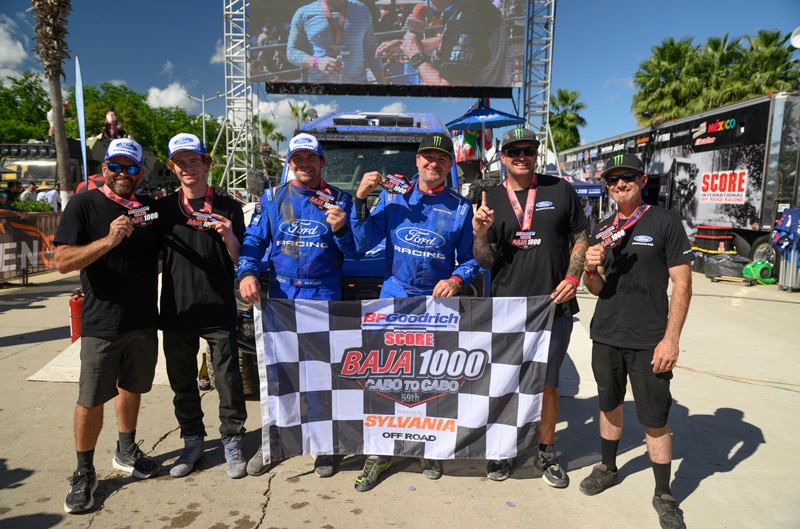
Their combined experience reflects the versatility demanded by the Bronco Raptor program, where the same fundamental vehicle philosophy must perform across high-speed desert racing, technical rock crawling and endurance competition. The combination of Lovell Racing and RTR harkens back to the days of the Rough Riders, when multiple teams came together under the Ford banner to race – and win – in the desert.
For Gittin Jr., whose relationship with Ford has grown from drifting into a wide-ranging off-road racing career, the Baja 1000 remains one of the sport's defining challenges.
“The reason Ford Racing is here is because they love off-road, the culture and the community, and they want to be part of it,” said Gittin Jr. “But we’re also developing in real time. To be part of something that will ultimately continue to put smiles on hundreds of thousands of Raptor owners’ faces in the future is a really cool thing.”
Healy, a multiple-time King of the Hammers champion and longtime Bronco competitor, brings a technical perspective shaped by years of competing at the highest levels of Ultra4 racing.
“There aren’t many perfect days in Baja, but I really feel like this team came as close as possible to having a perfect race,” said Healy. “It came from the planning, the development and the pretesting. There’s an army back here, and everyone deserves the credit — the co-drivers, the mechanics, the engineers. This team is pretty unreal. A lot of times we race against each other, but when we come together, it’s pretty hard to beat us. I can’t wait to see what the future holds for us, especially down here in Mexico. There’s nowhere else like Baja to prove how tough racing is and the durability of these vehicles. And it all ends up in the vehicles you get to drive home.”
Together with co-drivers Adam Lovell, Eric Davis and Jesse Amyx, the driving team navigated the challenges of the 2026 course while supported by a network of engineers, technicians and chase crews.
A DEFINING YEAR FOR FORD RACING OFF-ROAD
The victory at Baja concludes another significant chapter in Ford Racing's 2026 off-road campaign, a season that has demonstrated the breadth of its global racing ambitions.
At the Dakar Rally in January, Ford Racing secured a double podium with the Raptor T1+, as Nani Roma and Alex Haro finished second overall, followed by Mattias Ekström and Emil Bergkvist in third. The team also claimed six stage victories, continuing the rapid development of Ford's international rally-raid program.
Back on American soil, Ford Racing enjoyed a landmark King of the Hammers, where Brad and Adam Lovell claimed the Desert Challenge Limited class victory, Ford Bronco Raptors swept the Ultra4 4600 podium and Loren Healy captured the prestigious 4400 Race of Kings. Further victories followed at the Mint 400 and NORRA Mexican 1000, while Mitch Guthrie Jr. and Kellon Walch secured second overall at Vegas to Reno in the American desert racing debut of the Ford Raptor T1+.
The results reflect a global approach to off-road racing that connects Ford's production-based Raptor vehicles with specialized competition programs, each contributing to a shared understanding of performance, durability and capability.
The Baja 1000 remains one of the most important parts of that effort, providing an uncompromising test of the vehicles Ford builds and the people responsible for developing them.
125 YEARS OF RACING. NEARLY 60 YEARS OF BAJA
When Henry Ford won his first race in 1901, he established a relationship between competition and automotive innovation that would help shape the company's future. One hundred and twenty-five years later, that same belief continues to guide Ford Racing.
In Baja, where the original Bronco helped establish Ford's reputation in off-road competition, the connection between past and present is particularly visible. From the early pioneers who first raced across the peninsula to the engineers and drivers developing today's Raptor vehicles, the pursuit remains familiar.
The terrain has changed. The technology has advanced. Generations of drivers have come and gone.
But nearly six decades after Bronco first made its mark in Baja, Ford is still racing across the same desert, searching for the next improvement and the next victory.